
The inquiry began on a social platform.
The acquisition model used Facebook, Instagram, TikTok and Pinterest. At the time, the provider avoided Google because of click costs. An online opt-in was followed by telephone qualification and a process tied to the receiving firm’s representation agreement.
Our role covered the social acquisition work and the human handling that followed the response. The distinguishing detail in this engagement is the path from an opt-in to qualification and then to the buying firm’s own retainer.
Five topics guided telephone qualification.
Telephone screening covered case type, state, reported injuries, liability and insurance. These topics gave the qualification conversation a defined focus. Our team handled qualification and intake within that process.
For an intake director evaluating the model, the five topics identify the information discussed before the matter reaches firm review:
| Screening topic | Information discussed |
|---|---|
| Case type | The kind of matter described on the call. |
| State | The state reported by the prospective client. |
| Reported injuries | The person’s description of their injuries. |
| Liability | The person’s account of responsibility for the incident. |
| Insurance | The insurance information available during the call. |
The buying firm’s agreement was part of the process.
The model used the buying law firm’s own retainer, with signing before firm-specific delivery. Our work included intake and coordination toward that agreement.
For the firm, that makes the agreement and signing instructions part of the acquisition brief. Your intake lead needs to specify the retainer to use and the information reviewers expect. The firm retains its case assessment and representation responsibilities.
The client terms and order instructions defined the assignment.
Master service agreements and insertion orders defined client and order scope in this model. They organized the service and payment terms alongside identifiable acquisition assignments.
For your assignment, agree the order quantity alongside the screening criteria, retainer process and expected handoff. Your commercial and intake teams should be working from the same instructions.
Give your intake lead a concrete brief to work from.
Ask the intake leader who will review incoming matters to agree these instructions before the assignment begins:
- The case types and states your firm wants to consider.
- The qualification criteria and information to collect.
- The representation agreement and signing instructions.
- The documents, agreement status and open items to show at handoff.
- The firm’s review and representation responsibilities.
Review a sample handoff.
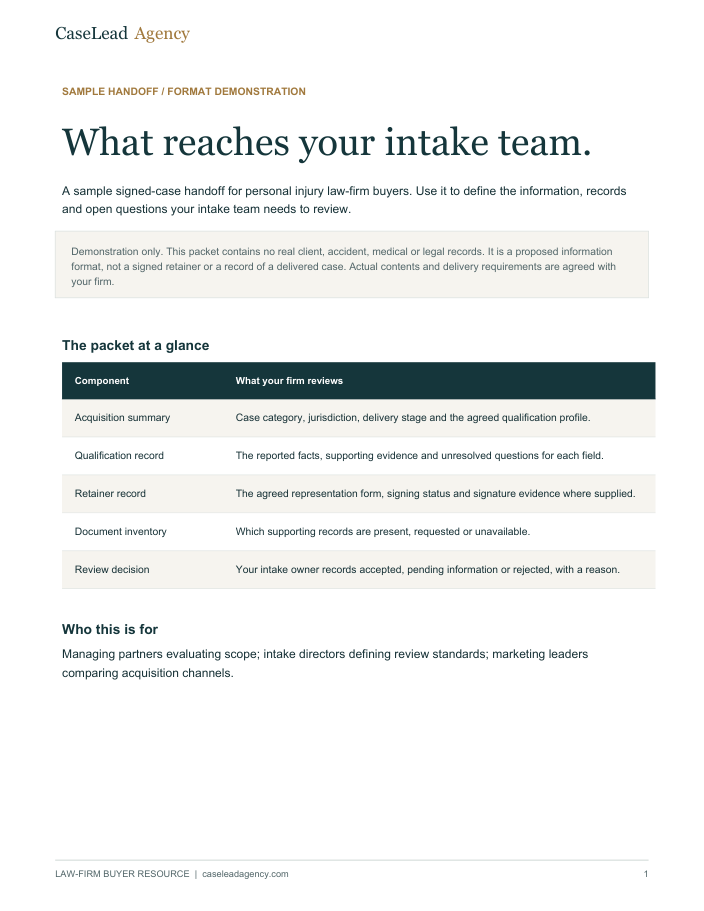
Open the sample packet to see how inquiry information, retainer status, documents and open items can be presented to your firm’s reviewers. Use it to agree what your team should receive.
- Acquisition and qualification information
- Retainer status and document inventory
- Open items and the firm’s review decision
Illustrative formats for planning your engagement. These resources contain no real client records.
Questions your firm may ask.
Whose retainer was used?
The buying law firm’s own retainer was used in this engagement, with signing before firm-specific delivery. For a new assignment, the agreement and signing responsibilities should be agreed with your firm in advance.
Did telephone screening decide whether the firm would represent the person?
The screening conversation covered the five stated topics. The receiving firm retained its assessment of the matter and its decisions about representation.
What should our intake director specify?
The director should define the case criteria, information to collect, retainer process, signing responsibilities and handoff reviewers expect. The sample packet shows a planning format for those information and document fields.
How were the client and order terms organized?
The provider model used master service agreements and insertion orders to define client and order scope, including service and payment terms. The relevant commercial and operating instructions should be clear before a new assignment starts.