
Multi-state buying architecture across five jurisdictions
Multi-state personal injury firms operating across California, Texas, Washington, Nevada, and Colorado face distinct media costs, statute deadlines, and bar-advertising rules in every office. Running a single blended order blurs performance and creates compliance risk in states with stricter solicitation statutes.
Instead, enterprise acquisition programs govern legal terms once in a Master Services Agreement (MSA) and issue state-scoped Insertion Orders (IOs) that isolate county targeting, bilingual intake staffing, daily pacing caps, and jurisdiction-specific fee structures. Following Colorado's C.R.S. 6-1-741 restrictions effective August 2026, Colorado campaigns run strictly as firm-branded, lawyer-identified advertising and intake programs rather than unbranded per-case lead resale.
| Jurisdiction | Primary compliance rule | Operational routing design | Intake staffing note |
|---|---|---|---|
| California (CA) | Cal. Rules 7.1-7.3 & B&P Code 6157 | County-segmented IOs (SoCal / Bay / Central Valley) | Dedicated English + Spanish telephone screening pods |
| Texas (TX) | Tex. Disciplinary Rules 7.01-7.06 | Metro blocks (Houston, DFW, Austin, San Antonio) | 24-hour review SLA tied to high-competition metros |
| Colorado (CO) | C.R.S. 6-1-741 (effective Aug 2026) | Lawyer-identified firm-branded ad + intake program | Fixed program billing; zero unbranded per-lead fee |
| Washington & Nevada (WA, NV) | RPC 7.2 & local ad disclosure rules | Regional expansion blocks paired with CA/TX hub | Unified CRM webhook tags by office and state |
Order cadence: 100-unit four-tranche blocks and 5x50 repeat orders
At enterprise volume (50 to 100+ signed MVA units per order), payment infrastructure and cash staging determine launch velocity. Generic online checkout links frequently enforce $30,000 per-link ceilings and 3.4% to 3.9% card surcharges, stalling $100,000 to $340,000 orders and creating unfamiliar third-party credit-card statement descriptors that trigger accounting holds.
High-volume engagements eliminate checkout friction by funding directly via branded ACH or wire transfers under signed Insertion Orders. Across observed enterprise blocks, firms either authorize a 100-unit ($340,000) block split across four scheduled tranches or run recurring 50-unit ($170,000) repeat cycles reconciled before the next tranche releases.
| Block structure | Billed unit quantity | Illustrative unit rate | Total recorded block | Funding & governance rail |
|---|---|---|---|---|
| Enterprise 100-unit block | 100 billed MVA units | $3,400 / unit | $340,000 | 4 staged wire/ACH tranches tied to delivery milestones |
| Repeat 50-unit cycle (5x) | 50 units x 5 consecutive orders | $3,400 / unit | $850,000 cumulative | Direct wire/ACH per 50-unit IO after cohort audit |
| Regional 30-unit cadence | 30 units per repeat order | $3,250 / unit | $97,500 per cycle | Wire/ACH or split milestone after 10-unit pilot |
Multi-vendor cohort governance and duplicate suppression
Anonymized market benchmark records confirm that top multi-state PI firms rarely rely on a single acquisition vendor. Instead, they run two or three providers simultaneously across signed retainers, exclusive OTP-verified leads, and warm live transfers so no single media disruption stalls case inventory.
Running parallel vendors requires strict cohort hygiene. Each supplier receives a dedicated CRM source tag, a timestamped delivery log, and a clear duplicate-suppression rule matching claimant phone, email, and incident date across a defined lookback window. Partners review cost per accepted case per vendor on identical 30-day review cohorts.
- Isolate every supplier under a unique CRM source ID (Filevine, Lead Docket, Litify, SmartAdvocate, or Lawmatics) so acceptance rates never blend.
- Define duplicate priority in writing: the first timestamped packet with verifiable consent receives attribution; subsequent overlaps trigger automatic credit or replacement.
- Track signed status, pending document requests, accepted cases, and declined cases in separate columns so cash spend always reconciles to accepted dockets.
- Hold bi-weekly decline-code reviews so paid-media buyers suppress underperforming zip codes, low-policy carriers, or soft-tissue profiles immediately.
Dedicated intake pods, bilingual screening, and CRM field mapping
Delivering 12 to 25 signed MVA files per week into a multi-state law firm breaks down if packets arrive as unstructured email attachments. Enterprise deployments map every screening field directly into the firm's case-management schema before the first media dollar launches.
A four-part handoff manifest accompanies every file: executed firm retainer with e-signature audit certificate, structured crash and injury intake summary, TCPA/opt-in consent proof with call audio, and an explicit open-items checklist flagging police reports, ER records, or insurance declaration pages still pending firm confirmation.
| Workflow stage | Acquisition partner role | Enterprise firm role | Target SLA |
|---|---|---|---|
| Campaign & screening | State-scoped paid media + bilingual human phone screen | Approves ad disclosures, counties, and exclusion criteria | Under 5 minutes from inquiry |
| Retainer execution | Coordinates signature on firm's approved fee agreement | Supplies current state-specific retainer template | Same-day signing coordination |
| Packet & CRM push | Delivers 4-part packet + structured CSV/webhook fields | Confirms receipt and assigns file to office intake reviewer | Real-time or daily batch sync |
| Acceptance & audit | Processes replacement/credit requests per written IO | Records Accepted / Declined / Pending decision in portal | 24 to 48 business hours |
How multi-state firms benchmark CaseLead before a 50-unit block
Even firms spending $150,000+ per month across incumbent vendors do not need to rip and replace their primary supplier to evaluate CaseLead. The cleanest operational path is a bounded 10- to 15-unit single-state benchmark slot run side-by-side against an existing vendor for 30 days.
Once your intake director verifies packet completeness, replacement-clock responsiveness, and real accepted-case cost on the opening cohort, the same MSA expands cleanly into 30-, 50-, or 100-unit multi-state Insertion Orders funded via direct wire or ACH.
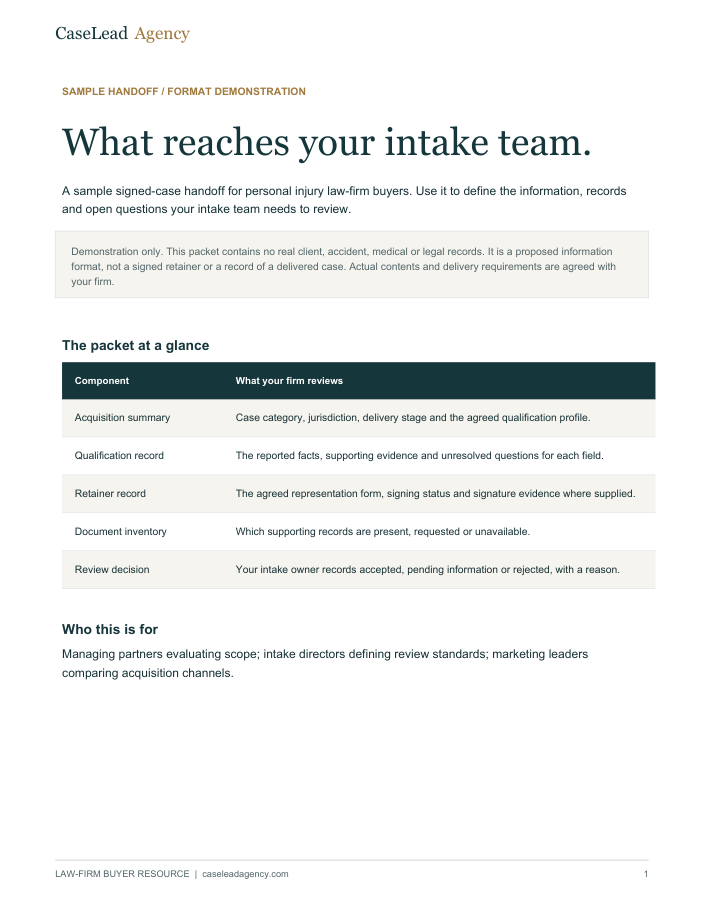
Inspect a sample handoff packet.
Explore the interactive portal demo or open the sample PDF packet to see how crash facts, consent logs, retainer status, and open items are packaged for your attorneys before you ever commit to an order.
- Acquisition source, TCPA opt-in & screening summary
- Executed firm retainer & document manifest
- Flagged open items & 24–48 hour firm review decision
Structured packet & export delivery compatible with Filevine · Lead Docket · Lawmatics · CASEpeer · Litify · SmartAdvocate · Clio Grow · Neos. Illustrative sample formats contain no live client records.
Questions managing partners and intake directors ask.
Can CaseLead run alongside our existing MVA case acquisition vendors?
Yes. Multi-sourcing is standard among high-volume PI firms. We tag every packet with a dedicated CRM source ID and agree written duplicate-suppression rules so your partners can benchmark CaseLead's accepted-case cost directly against incumbent suppliers.
How does direct wire or ACH billing avoid $30,000 payment-link bottlenecks?
Many legal-marketing sellers rely on third-party checkout links capped at $30,000 per transaction with 3.4% to 3.9% card markups. CaseLead invoices enterprise blocks directly via branded ACH or wire under a signed MSA and Insertion Order with staged delivery tranches and zero card-cap delays.
How are bar-restricted states handled inside a multi-state footprint?
We never apply one blanket fee structure across states with conflicting ethics opinions. States restricting per-signed-client fees (including NY, FL, NJ, PA, CO, MD, and CT) are scoped on separate Insertion Orders as firm-branded advertising and human intake program costs reviewed by your ethics counsel.
What CRM platforms can receive structured enterprise handoff packets?
CaseLead delivers structured PDF packets, field maps, and CSV/webhook exports aligned to Filevine, Lead Docket, Litify, SmartAdvocate, Lawmatics, CASEpeer, Clio Grow, and Neos.
Do we have to start at 50 or 100 units?
No. Enterprise firms routinely start with a bounded 10- to 15-unit benchmark block in one or two priority states to validate packet integrity and intake handoff before authorizing 50- or 100-unit tranches.