
Why boutique and regional PI firms buy in 4- to 20-case blocks
Across anonymized 2025-2026 legal-acquisition transaction records, regional personal injury firms overwhelmingly favor discrete 4-, 5-, 10-, 15-, and 20-case Insertion Orders over open-ended monthly retainers. Modular blocks match cash outlay directly to attorney caseload capacity and create natural review checkpoints every 30 to 45 days.
A firm adding 5 to 15 new motor-vehicle files per month needs predictable pacing, transparent per-unit economics, and fast first-file turnaround (targeting 14 to 21 days from brief approval rather than 45-day prepay dead zones). Once a 10-case pilot reconciles cleanly, partners simply execute the next 10- or 20-case Insertion Order under the existing MSA.
| Modular pack tier | Illustrative unit rate* | Total pack commitment | Recommended funding rail | Ideal firm profile |
|---|---|---|---|---|
| 4- to 5-case micro test | $3,250-$3,500 | $13,000-$17,500 | 50/50 milestone split or ACH | Solo or 2-3 attorney firm testing first signed-case channel |
| 10-case starter pilot | $2,800-$3,500 | $28,000-$35,000 | 50% launch / 50% midpoint ACH | Regional PI firm benchmarking against PPC or incumbent vendor |
| 15-case regional block | $3,250-$3,500 | $48,750-$52,500 | Direct ACH / wire (zero card cap) | Growing multi-attorney firm scaling steady monthly dockets |
| 20-case scale block | $3,250-$3,500 | $65,000-$70,000 | Staged wire/ACH tranches | Established regional practice running predictable reorder cycles |
Eliminating prepay cash lockup with 50/50 split-milestone pilots
The single biggest objection managing partners raise when evaluating a new signed-case vendor is full upfront prepayment paired with 30 to 45 days of silence before the first packet arrives. That cash lockup unfairly shifts execution risk entirely onto the law firm.
CaseLead addresses starter friction by offering bounded 4- to 10-case pilots with optional 50/50 split-milestone funding where permitted: 50% at brief approval to fund dedicated campaign launch and human intake staffing, and the remaining 50% triggered only once the opening delivery milestone reaches your intake desk and clears initial packet verification.
- Day 1-3: Sign MSA + bounded Insertion Order, finalize county exclusions, upload firm retainer template, and verify CRM delivery format.
- Day 4-10: Launch dedicated campaigns and bilingual human telephone screening against the written five-gate injury and liability profile.
- Day 14-21: Opening signed packets reach your intake reviewer with full TCPA opt-in proof, call audio, and flagged open items.
- Midpoint checkpoint: Verify packet compliance and replacement responsiveness before releasing Milestone 2 or queuing the next 10- to 20-case block.
Protecting effective cost per accepted case on smaller cohorts
On a 50-unit order, one uncredited out-of-criteria file moves effective cost by roughly 2%. On a 4-case or 10-case pilot, two uncredited declines can swing true cost per accepted case by 25% to 50%.
Therefore, smaller modular packs depend heavily on tight pre-delivery screening gates and explicit written replacement criteria (wrong state, prior counsel already retained, no injury or medical treatment intent, claimant at fault where excluded, or unreachable within the agreed verification window).
| Illustrative 10-case pilot scenario | Billed pack ($3,250/unit) | Firm-accepted cases | Reconciled replacements | Effective supplier cost / accepted |
|---|---|---|---|---|
| Strong fit (9 of 10 accepted) | $32,500 | 9 accepted | 1 replaced cleanly | $3,250 (10/10 net) |
| Standard pilot (8 of 10 accepted, no replacement) | $32,500 | 8 accepted | 0 credited | $4,063 |
| Standard pilot (8 accepted + 2 replaced) | $32,500 | 10 accepted net | 2 out-of-criteria replaced | $3,250 |
| Unscreened vendor (5 of 10 accepted, no credit) | $32,500 | 5 accepted | 0 credited | $6,500 |
Why MSA + IO + packet manifests keep billing disputes near 0%
Anonymized market payment benchmarks reveal a sharp structural contrast: legal-marketing sellers operating on vague monthly retainers or opaque clinic/ad-spend bundles show 17% to 20% billing dispute rates, whereas structured signed-case programs governed by an MSA, Insertion Order, and timestamped handoff proof show near-0% disputes.
Clear contract mechanics protect both sides. When the exact qualifying criteria, 4-part packet contents, 48-hour to 7-day written review window, and clean CaseLead-branded ACH/wire invoice descriptors are agreed before launch, managing partners and accounting teams never face surprise charges or ambiguous deliverables.
Graduating from a 10-case starter pack to predictable monthly reorders
Just as Engagement 01 moved from a 10-unit test into four consecutive 30-unit blocks, regional firms scale safely when each reorder uses real cohort feedback. At the close of an opening 5- or 10-case pack, partners review three metrics: contact-to-onboarding speed, medical-treatment verification rate, and accepted-case cost.
In bar-restricted states (including New York, Florida, New Jersey, Pennsylvania, Colorado, Maryland, and Connecticut), modular pilots follow the same bounded testing philosophy—scoped as fixed-budget, firm-branded advertising and human intake sprints rather than per-signed-client fees.
Inspect a sample handoff packet.
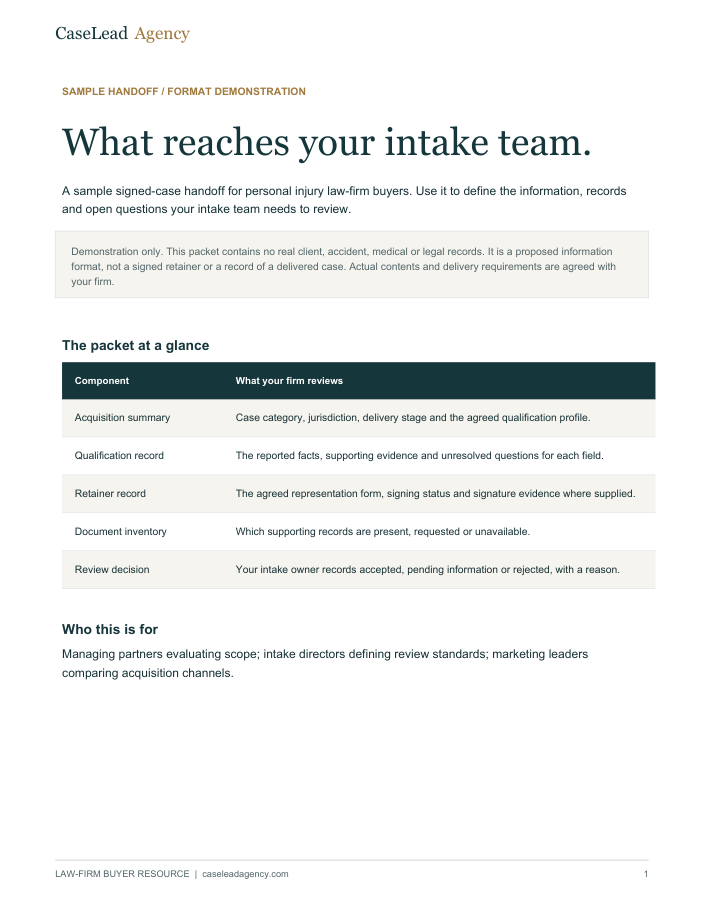
Explore the interactive portal demo or open the sample PDF packet to see how crash facts, consent logs, retainer status, and open items are packaged for your attorneys before you ever commit to an order.
- Acquisition source, TCPA opt-in & screening summary
- Executed firm retainer & document manifest
- Flagged open items & 24–48 hour firm review decision
Structured packet & export delivery compatible with Filevine · Lead Docket · Lawmatics · CASEpeer · Litify · SmartAdvocate · Clio Grow · Neos. Illustrative sample formats contain no live client records.
Questions managing partners and intake directors ask.
What is the smallest signed MVA pack a regional firm can start with?
Depending on your state and county criteria, bounded starter pilots typically begin at 4 to 10 signed MVA cases (where state bar rules permit per-retainer pricing) or an equivalent 30-day fixed firm-branded advertising and intake sprint in bar-restricted states.
How does 50/50 split-milestone funding work on a starter pilot?
For approved starter pilots, 50% funds campaign setup, media launch, and human intake staffing, and the remaining 50% is invoiced once the agreed opening delivery milestone is delivered and passes packet verification.
Why does CaseLead publish $2,800-$3,800 when market packs cluster around $3,250-$3,500?
Standard passenger-auto retainers across competitive U.S. metros typically clear between $3,000 and $3,500 depending on state media CPCs, injury/treatment gates, and pack volume. Publishing $2,800-$3,800 gives partners an honest planning range upfront—unlike 8 of 13 tracked signed-case sellers that hide pricing completely.
What triggers a replacement or credit on a modular pack?
Every Insertion Order specifies exact replacement triggers in writing before launch—commonly including wrong jurisdiction, existing legal representation, claimant at fault where excluded, no reported injury, or duplicate incident—paired with a clear 48-hour to 7-day review clock.
Are modular packs available in New York, Florida, New Jersey, or Pennsylvania?
Yes, using bar-compliant program structures. Because those states treat per-signed-client fees as prohibited referral fees, CaseLead structures bounded pilots there as transparent firm-branded advertising and human telephone intake programs billed on fixed program milestones.